




Saudi Rule Update Hits Aquarium Pump Certification




On June 5, 2026, Saudi Arabia’s SASO released the updated GSO 2530:2026 standard, and its practical impact has moved beyond household appliances into export compliance for motor-driven fluid equipment. What deserves close attention is that commercial aquarium circulation pumps and protein skimmers have reportedly been caught in actual customs enforcement, making this development relevant not only to appliance-related suppliers, but also to manufacturers, exporters, compliance teams, and buyers involved in high-end aquatic equipment shipments to Saudi Arabia.
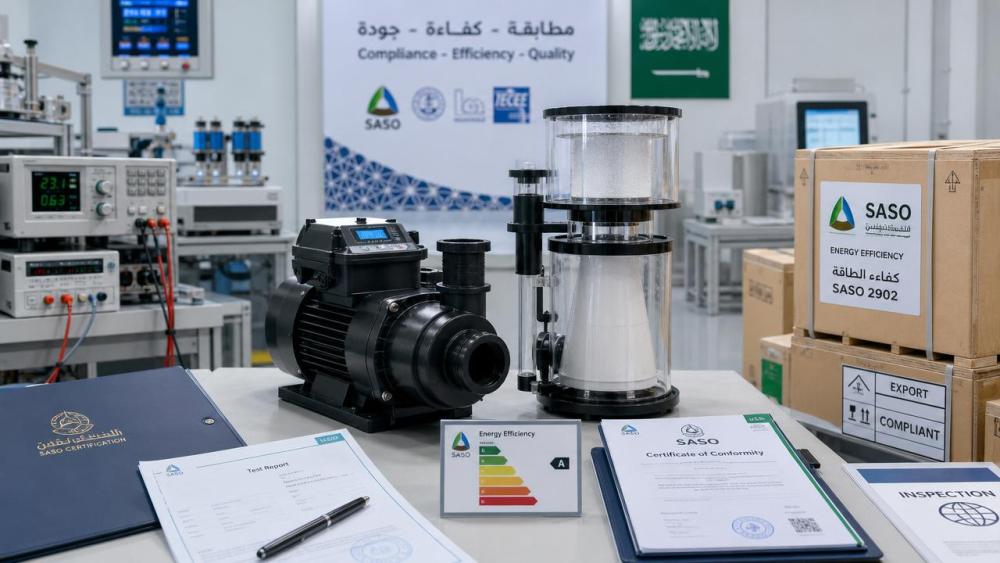
What the new Saudi requirement now covers in practice
According to the provided information, SASO issued the new GSO 2530:2026 standard on June 5, 2026. The standard requires all motor-driven fluid equipment entering Saudi Arabia, including pumps, filters, and protein skimmers, to pass three tests: hydraulic efficiency (η_hyd), standby power consumption, and smart control protocol compatibility.
The provided summary also states that although the standard is aimed at home appliances, Saudi customs has in practice extended its application to commercial aquarium circulation pumps and protein skimmers. As a result, multiple shipments of Chinese-made Marine Circulation Pumps were returned because they lacked Matter-over-IP or Thread protocol certification.
Where the pressure is likely to appear across the trade chain
Exporters face a narrower certification path
From an industry perspective, direct trading companies are likely to feel the impact first because customs enforcement affects shipment release rather than only product design. The main pressure point is documentation and market-entry compliance: products previously prepared under a narrower product interpretation may now face additional protocol and performance test expectations before clearance.
Manufacturers may need to reassess product definitions
For manufacturers of aquarium circulation pumps, filters, and protein skimmers, the issue is not only technical testing but also product categorization in export practice. If a product is treated by customs as falling within the expanded scope of motor-driven fluid equipment, design features linked to standby power and smart control compatibility may become part of the certification review path.
Supply chain and delivery teams could see fulfillment disruption
Supply chain service providers, logistics coordinators, and order-fulfillment teams may be affected because returned shipments create uncertainty around delivery schedules, acceptance checks, and rework planning. What deserves closer attention is whether existing outgoing orders contain products that could be interpreted under the same enforcement approach.
Buyers and channel partners need clearer pre-shipment alignment
Importers, distributors, and procurement-side stakeholders may face additional due diligence burdens. The practical issue is whether supplied products can demonstrate conformity not only in conventional equipment terms, but also in the specific compatibility expectations now being applied in customs handling.
What companies should review right now
Watch the gap between written scope and actual enforcement
Analysis shows that the most immediate risk lies in the difference between the formal appliance-oriented framing of the standard and its actual extension to commercial aquarium equipment at customs. Companies should therefore distinguish between the text of a rule and the way it is being enforced in shipment review.
Check whether target models involve smart protocol expectations
The reported returns linked to missing Matter-over-IP or Thread certification make protocol compatibility a practical checkpoint, not just a technical detail. Firms shipping motor-driven aquatic equipment to Saudi Arabia should closely review whether the affected models could be asked to demonstrate this aspect during market entry.
Reconfirm paperwork, supplier readiness, and lead times
Where shipments depend on third-party manufacturing or component sourcing, companies should review whether technical files, test evidence, and supplier declarations are consistent with the new three-part testing expectation. This is especially relevant for orders already in production or near dispatch, where certification gaps can quickly turn into delivery delays.
Prepare customer communication around compliance uncertainty
Observably, customer communication now matters as much as internal compliance review. Exporters and suppliers may need to explain possible clearance risks, revised timelines, or documentation requirements to Saudi-side customers before shipment rather than after a customs issue emerges.
Why this should be read as a regulatory signal, not just a one-off shipment issue
Analysis shows that this development is meaningful because it links three compliance dimensions—hydraulic efficiency, standby power, and smart control protocol compatibility—under a market-access outcome that has already affected commercial aquatic equipment. It is more appropriate to understand this as an operational compliance signal with immediate trade relevance, while also recognizing that the full regulatory boundary still requires continued observation.
Observably, the key issue is not simply that a standard was updated, but that enforcement appears to be extending across product categories in a way that changes certification expectations for exporters who may not have treated aquarium pumps or protein skimmers as falling within an appliance-linked framework.
How the market should interpret the development at this stage
At this stage, the event is best understood as a concrete compliance warning with broader implications for exporters of motor-driven aquatic equipment to Saudi Arabia. It does not yet confirm every future enforcement detail, but it does show that relying on a narrow reading of product scope may no longer be sufficient. For the industry, the rational takeaway is to treat this as both a current shipment risk and a signal to monitor how standards language translates into customs practice.
Basis of this article and points still requiring verification
This article is generated based on the user-provided news title, event date, and event summary. The information discussed here relates to the types of materials typically associated with such developments, including official notices, standards documents, customs-related enforcement signals, company disclosures, industry association updates, and reporting by authoritative trade media.
A specific official source link was not provided in the input, so further verification remains necessary. Follow-up attention should focus on whether Saudi authorities issue more detailed wording on product scope, whether enforcement treatment for commercial aquarium circulation pumps and protein skimmers becomes more explicit, and how protocol compatibility requirements are documented in actual certification and customs review processes.
Related News
- How to Program Reef Tank Water Flow to Reduce Dead Spots Without Stressing CoralsOct 19, 2026Master programmable aquarium water movement to reduce reef tank dead spots without stressing corals. Discover smarter pump placement and schedules for a healthier, cleaner reef.
- Selecting Tide Simulation Systems for Public Aquariums: Flow, Scale, and ReliabilitySep 17, 2026Public aquarium Tide Simulation Systems: compare flow design, scale, animal welfare, controls, and maintenance to select reliable, high-impact solutions.
- Selecting Modular Reef Tank Equipment for Stable Coral Growth and Water FlowSep 15, 2026Modular reef tank equipment guide: optimize flow, filtration, lighting, and controls for stable coral growth, easier maintenance, and reliable system performance.
- How to Choose Aquarium Emergency Power Systems for Pumps, Heaters, and Life SupportJul 23, 2026Aquarium Emergency Power Systems: learn how to choose backup solutions for pumps, heaters, and life support with the right runtime, transfer speed, and reliability.
Related Industries
Trending in Tech
 Commercial Aquarium Life Support Systems: Sizing for Peak BioloadsOct 26, 2026Size commercial aquarium life support systems for peak bioloads. Learn how to match filtration, oxygen, flow, and backup capacity to real demands—and compare suppliers with confidence.
 Legal Gaps Expose Global Wildlife Supply Chains to Illegal Pet Trade RisksOct 26, 2026Wildlife supply chain gaps expose reptile and amphibian trade to illegal pet trafficking. Explore CITES compliance risks and practical checks to help protect your business.
 Commercial Aquarium LED Lighting: Evaluating PAR and Coverage in Deep Reef TanksOct 25, 2026Compare commercial aquarium LED lighting with depth-specific PAR maps, spectrum, and coverage data. Discover how to reduce hotspots and choose the right layout for deep reef tanks.

Weekly Insights
Stay ahead with our curated technology reports delivered every Monday.