




Why aquarium life support systems need redundancy




For commercial aquariums, public exhibits, and high-value marine collections, failure is not an inconvenience—it is a direct threat to livestock, revenue, reputation, and operational continuity. That is why aquarium life support systems must be evaluated not only by capacity, efficiency, or technology, but by redundancy. From pumps and oxygenation to filtration, monitoring, and emergency power, layered backup architecture determines whether an artificial ecosystem survives equipment faults, human error, or power disruption without catastrophic loss.
Why aquarium life support systems need redundancy
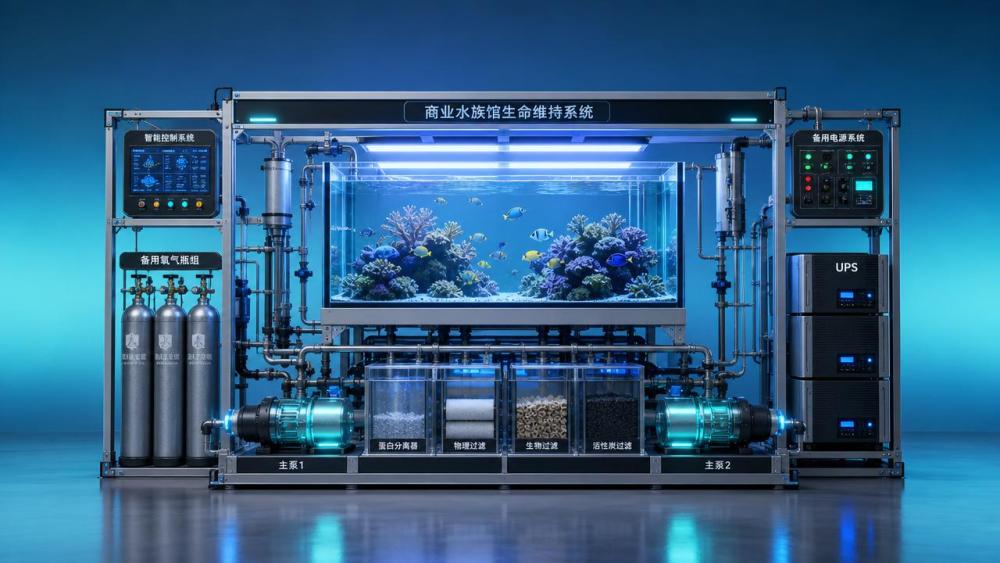
Aquarium life support systems are artificial organs for closed aquatic habitats. They move water, remove waste, exchange gases, stabilize temperature, and protect fragile biology.
In nature, oceans dilute error. In tanks, every fault concentrates quickly. A stopped pump can become a lethal event within minutes.
Redundancy means one failure does not trigger system collapse. It turns a crisis into a controlled maintenance event.
Why checklist-based evaluation matters
Aquarium life support systems often look stable during normal operation. Risk appears only when a component fails, power drops, or biological load spikes.
A checklist forces every critical function to be examined separately. It prevents overconfidence in oversized pumps, premium skimmers, or advanced controllers.
The goal is not simply buying more equipment. The goal is designing independent layers that fail safely and recover predictably.
For aquarium life support systems, redundancy should cover mechanical, electrical, hydraulic, biological, and operational weak points.
Core redundancy checklist for aquarium life support systems
- Map every life-critical function first, including circulation, oxygenation, filtration, heating, cooling, dosing, drainage, alarms, emergency power, and manual bypass paths.
- Split circulation across multiple pumps, so one failed motor reduces flow but never stops total turnover through essential aquarium life support systems.
- Install check valves, isolation valves, and union fittings to service pumps without draining sumps, flooding equipment rooms, or interrupting oxygen delivery.
- Provide independent aeration or oxygen injection, because strong water movement alone cannot guarantee dissolved oxygen during pump or skimmer downtime.
- Separate mechanical filtration stages, allowing filter socks, drums, foam blocks, or screens to clog without starving downstream biological filtration.
- Oversize biological media conservatively, then protect it from drying, chemical shock, and sudden flow loss during maintenance or outage events.
- Use dual heaters or staged heat sources with independent thermostats, preventing one stuck relay from overheating rare fish, coral, or reptiles.
- Design cooling redundancy with backup fans, chillers, or heat exchangers, especially where lighting, pumps, and room temperature create heat load.
- Add high-water, low-water, leak, temperature, pH, ORP, salinity, and flow alarms that report locally and remotely through separate channels.
- Protect controllers with manual overrides, because smart automation improves aquarium life support systems only when basic functions remain operable without software.
- Place critical devices on labeled circuits, surge protection, UPS units, or generators, based on acceptable runtime and livestock sensitivity.
- Document emergency actions in plain steps, so feeding stops, aeration starts, valves close, and water changes begin without improvisation.
Application notes for different aquatic environments
Public aquariums and large commercial exhibits
Large exhibits carry high biomass and public visibility. Aquarium life support systems must handle animal welfare, visitor safety, and operational reputation together.
Redundancy should include parallel pump trains, standby protein skimmers, oxygen manifolds, backup sensors, emergency drains, and generator-supported circulation loops.
For giant cylindrical tanks, hydraulic planning matters. A backup pump is useless if pipework cannot route water during isolation or repair.
Coral reef systems and SPS-dominant displays
Reef tanks punish instability. SPS corals react to oxygen swings, temperature drift, alkalinity shocks, light failure, and nutrient spikes.
Aquarium life support systems for coral should protect flow patterns, skimmer capacity, dosing reliability, and thermal stability during equipment faults.
Lighting is not only visual. Redundant photoperiod control can prevent coral stress when LED drivers, timers, or controllers fail unexpectedly.
High-end aquascaping and planted aquariums
Planted systems depend on circulation, CO2 distribution, temperature control, and nutrient balance. Failure rarely looks dramatic at first.
Aquarium life support systems for aquascaping should include backup flow, anti-siphon protection, dosing safeguards, and alarms for CO2 regulator faults.
A beautiful ultra-clear tank still needs industrial thinking. Invisible engineering protects visible nature.
Quarantine, breeding, and holding systems
Quarantine systems often run with temporary equipment. That makes redundancy even more important, not less important.
Aquarium life support systems in holding rooms should isolate disease risk while maintaining independent aeration, heat, filtration, and emergency water movement.
Breeding stock may represent years of selection. Small heaters, air pumps, and sensors can prevent irreversible loss.
Common redundancy mistakes that create hidden risk
Relying on one oversized pump
A single powerful pump creates a single point of failure. When it stops, the entire hydraulic chain may collapse instantly.
Better aquarium life support systems divide flow across duty and standby equipment, or run multiple smaller pumps in parallel.
Backing up devices but not power
Spare pumps cannot help during a blackout if no protected circuit, UPS, battery, or generator keeps them running.
Emergency power planning should prioritize oxygenation, circulation, temperature control, and monitoring before non-critical lighting or decorative equipment.
Using one controller for everything
Smart controllers are useful, but excessive centralization creates software dependency. One frozen processor can disable multiple protections.
Critical aquarium life support systems should keep hardwired fallbacks, independent thermostats, and manual switching for essential devices.
Ignoring maintenance access
Redundancy fails when backup equipment cannot be reached, isolated, cleaned, or tested without disrupting the live system.
Valves, unions, drains, labels, and safe working space are part of serious aquarium life support systems, not optional accessories.
Forgetting biological redundancy
Mechanical backup is not enough. Nitrifying bacteria, refugia, live rock, bio-media, and denitrification zones also need resilience.
Protect biological filtration from drying, medication exposure, chlorine, temperature shock, and sudden oxygen depletion.
Practical steps for implementing redundancy
- Audit existing aquarium life support systems by listing each device, its function, power source, failure impact, and available backup path.
- Rank risks by survival time, starting with oxygen, circulation, temperature, and toxic waste accumulation during worst-case conditions.
- Test one failure at a time under controlled conditions, including pump shutdown, sensor loss, clogged filtration, and power interruption.
- Record actual response times, alarm behavior, sump levels, temperature drift, dissolved oxygen trends, and operator actions.
- Upgrade the weakest link first, because aquarium life support systems are only as reliable as their most vulnerable function.
- Schedule recurring drills, spare-part checks, battery tests, generator runs, probe calibration, and valve operation reviews.
Redundancy should be verified, not assumed. A backup pump sitting dry for two years may not start when livestock depends on it.
Documentation matters as much as hardware. Clear diagrams shorten diagnosis time during leaks, alarms, and power events.
Every aquarium life support systems plan should include spare impellers, air stones, heater units, tubing, sensors, fuses, saltwater, and test kits.
Summary and action guide
Redundancy is the difference between controlled degradation and catastrophic failure. It gives an artificial ecosystem time to survive problems.
Effective aquarium life support systems do not depend on one pump, one circuit, one sensor, one controller, or one maintenance habit.
Start by identifying the fastest livestock-killing failure. Then build independent backup layers around that function before improving secondary features.
For commercial exhibits, reef displays, breeding rooms, and luxury aquascapes, resilient aquarium life support systems protect biology, investment, and continuity.
Review the checklist, test real failure scenarios, and document recovery steps. Reliability is designed before emergencies, not during them.
Related News
- Choosing an Aquarium Ozone Treatment System: Sizing, ORP Control, and SafetyOct 24, 2026Choose an aquarium ozone treatment system with confidence. Explore sizing, ORP control, and essential safety measures to protect livestock and compare suppliers before you buy.
- What Does a Coral Dosing System Cost to Buy, Run, and Maintain?Oct 10, 2026Coral dosing systems cost explained: compare purchase, operating, maintenance, accuracy, and five-year ownership costs to choose the right reef dosing solution.
- Selecting Multi-Channel Reef Dosing Systems for Stable Alkalinity and Trace ElementsOct 03, 2026Multi-channel reef dosing systems for stable alkalinity and trace elements: explore accuracy, independent channels, calibration, chemical safety, and monitoring features.
- How to Plan Filtration, Life Support, and Staffing for Large Public AquariumsOct 01, 2026Large public aquarium operations: plan resilient filtration, life support, monitoring, and staffing to protect animal welfare and improve operational reliability.
Related Industries
Trending in Tech
 Commercial Aquarium Life Support Systems: Sizing for Peak BioloadsOct 26, 2026Size commercial aquarium life support systems for peak bioloads. Learn how to match filtration, oxygen, flow, and backup capacity to real demands—and compare suppliers with confidence.
 Legal Gaps Expose Global Wildlife Supply Chains to Illegal Pet Trade RisksOct 26, 2026Wildlife supply chain gaps expose reptile and amphibian trade to illegal pet trafficking. Explore CITES compliance risks and practical checks to help protect your business.
 Commercial Aquarium LED Lighting: Evaluating PAR and Coverage in Deep Reef TanksOct 25, 2026Compare commercial aquarium LED lighting with depth-specific PAR maps, spectrum, and coverage data. Discover how to reduce hotspots and choose the right layout for deep reef tanks.
Weekly Insights
Stay ahead with our curated technology reports delivered every Monday.